
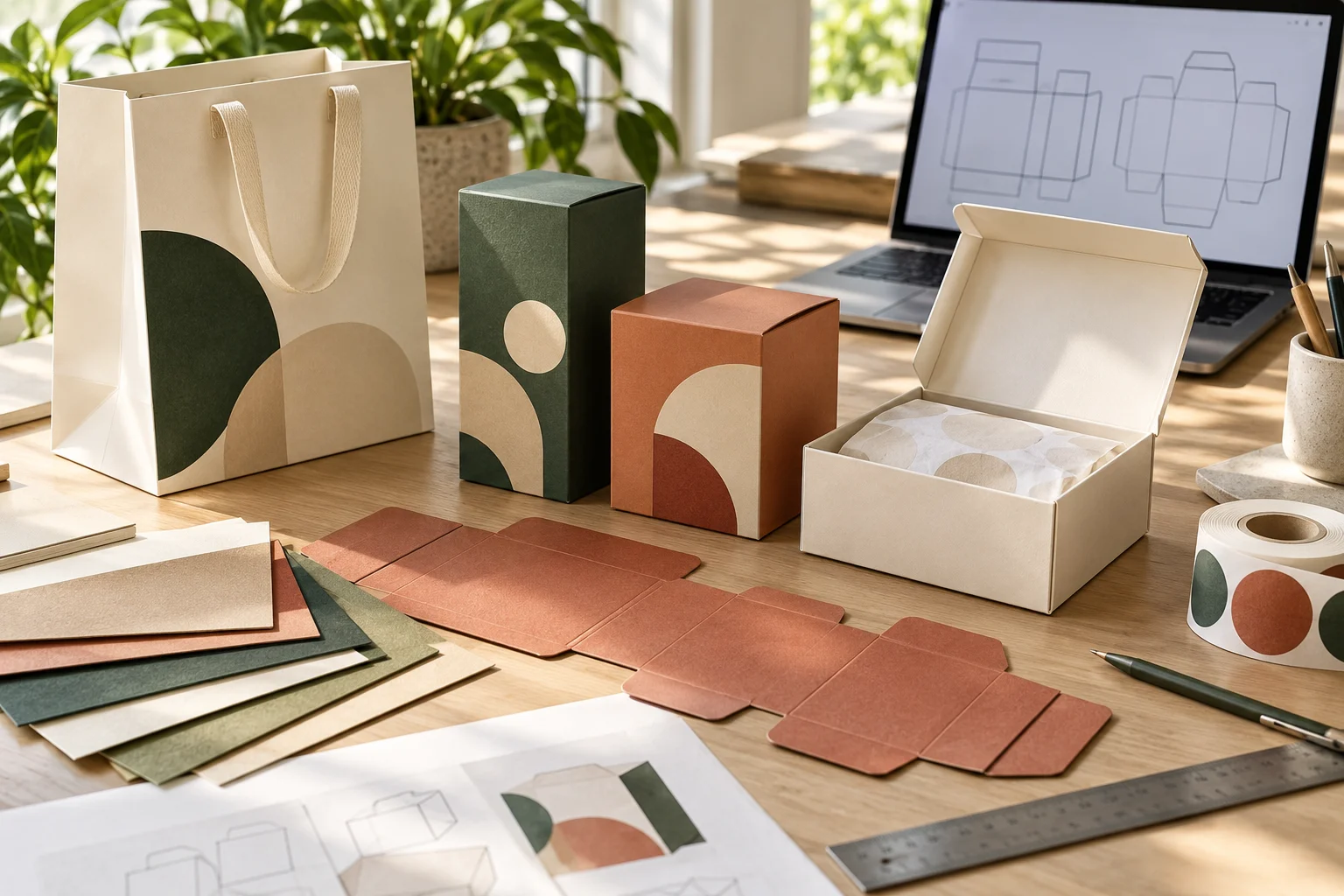
Ordering overseas can give a growing business more packaging options. This guide explains how to hand over a local design, compare quotations and choose a sample before committing to production.
1. Prepare the brief
Send product dimensions, weight, intended use, order quantity, delivery destination and required arrival date. For bags, describe the contents and carrying weight. For boxes, include the finished product and accessories. For stickers, identify the application surface and intended conditions. Reference images help, but measurements make the quotation useful.
2. Choose a design route
A local designer can prepare the branding and send production-ready artwork to the overseas factory. Request the factory’s approved dieline first; it shows the cutting and folding layout. Ask the factory to check file suitability before production.
If design support is needed, discuss an overseas specialist team or supplier service. Confirm whether the scope includes structural development, artwork layout or both. Agree on fees, revisions and ownership of the final files. A logo alone is a starting point, not production-ready artwork.
3. Compare the delivered cost
Request matching quantities, dimensions, materials, printing and finishes. Include design, samples, production, freight, applicable import charges and final delivery. Divide the complete total by the quantity for a comparable delivered unit cost.
Illustration only: a $2,400 local total and a $1,800 overseas delivered total would mean a $600 saving, or 25%. These are invented figures, not HuaJia prices or a guaranteed saving. Actual savings depend on matched quotations. Smaller local orders may still suit urgent or uncertain demand.
4. Choose a suitable sample
A digital artwork proof is an electronic file for checking wording and layout. It does not establish physical fit, paper feel or finished colour.
A digital printed sample is physical. It is generally less expensive than production-press sampling and can help review layout, size and assembly. Ask whether it uses the intended material. Colour and special finishes may differ from production.
A production-press sample uses the intended production printing process. Setup generally makes it more expensive and slower. For small orders, consider whether that expense is justified by a critical colour or finish. Ask exactly which production features will be reproduced; the term “press sample” alone does not settle the scope.
5. Receive and approve the sample
A physical sample can be mailed by agreement. Sampling and courier fees may apply. Confirm both charges and ask whether any sample payment is credited against a later order. A credit is not automatic.
Try the actual product in the sample. Check fit, print placement, handles, closures and inserts as applicable. Record the sample version, final artwork and agreed limitations in writing. Changes after approval may require another check.
6. Confirm production and delivery
Confirm the quantity, specification, payment terms, inspection arrangements and delivery responsibilities in writing. Ask which approval or payment starts the production schedule. Allow for revisions, sampling and transport instead of relying on a generic lead-time estimate.
Keep the approved files and reference sample for repeat orders. If the product, artwork or structure changes, identify the checks that need repeating.
Discuss a project with HuaJia
HuaJia supplies custom paper bags, product boxes, gift boxes, cartons and stickers. Order quantities are flexible according to the structure, material and finish. Send dimensions, quantity, artwork or reference images and the delivery destination to discuss a quotation and sampling options.
Pingback: Packaging Artwork: Ready for Print - HuaJia Printing Factory China | Professional Custom Packaging Solutions
Pingback: Choose the Right Packaging Insert - HuaJia Printing Factory China | Professional Custom Packaging Solutions
Pingback: Looking for a Custom Packaging Manufacturer? Here’s What Every Buyer Should Know
Pingback: Packaging Reorder Checklist | HuaJia