
E flute and B flute describe corrugated profiles, not a guaranteed shipping weight limit. To choose a custom mailer box, compare the complete board grade, the box structure, product support and the delivery route. Then approve a loaded sample against agreed protection requirements.
This guide explains E flute vs B flute for mailer boxes, what ECT tells you, and what to put in a packaging enquiry. The aim is to make different quotations comparable before you invest in artwork and production.
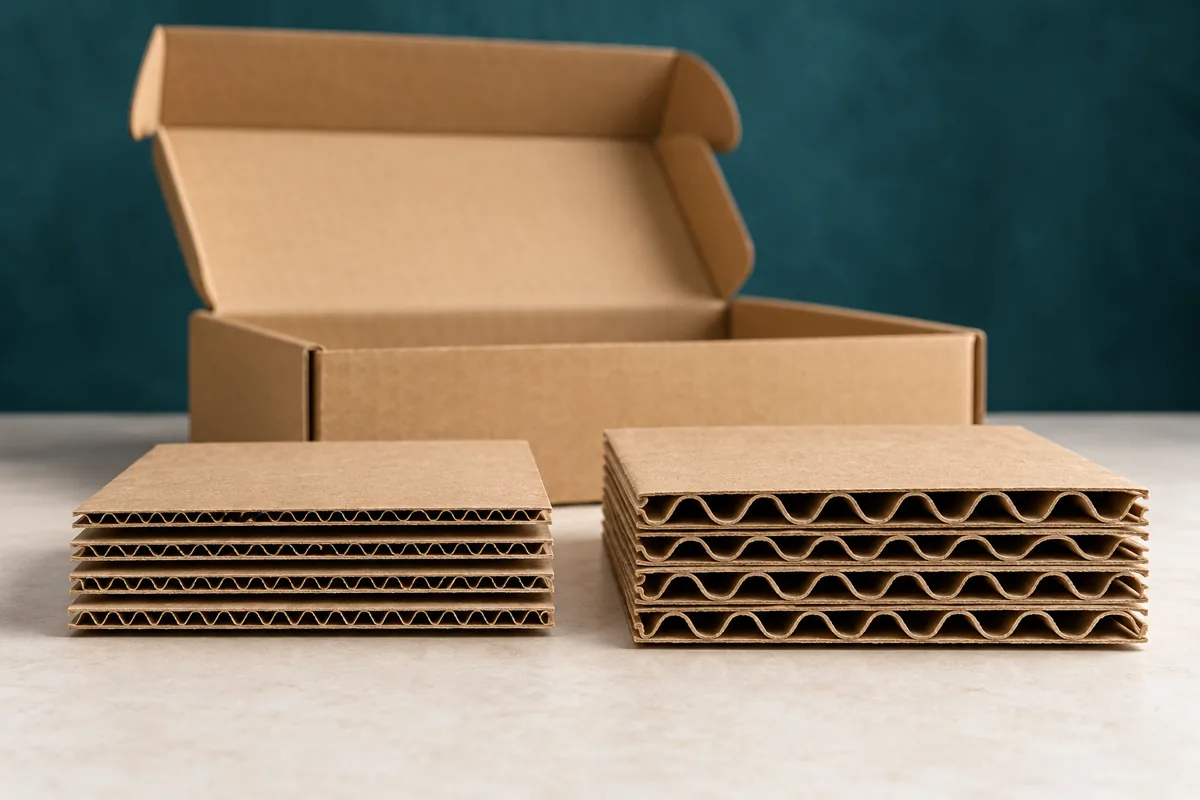
What the flute letter describes
Corrugated board combines flat liners with a fluted paper medium. Single-wall board has one fluted layer between two liners. Double-wall board uses two fluted layers and an additional liner. The flute profile is one part of that construction.
| Option | General design consideration | Questions for the sample brief |
|---|---|---|
| E flute | A relatively fine profile; often evaluated for compact die-cut packs and printed presentation. | Does the proposed grade support the loaded pack? Do edges and corners remain acceptable after testing? |
| B flute | A thicker profile than E in typical constructions; used in a broad range of die-cut and shipping cases. | How does the extra board thickness affect the folded walls, external size and closure? |
| EB double wall | Combines E and B profiles in a double-wall construction. | Is the added construction needed for this route, and can the proposed structure assemble cleanly? |
As one manufacturer’s published examples, Smurfit Westrock Atlas lists E flute at about 1.3–1.6 mm and B flute at about 2.6–3.0 mm. These are reference ranges, not acceptance tolerances for your order. Confirm the actual finished board caliper with the supplier, particularly for a laminated construction.
Do not compare two proposals on the flute letter alone. Ask for liner and medium specifications, total construction, actual caliper and available strength data. A white printed outer liner also tells you little about the rest of the board.
ECT: board edge crush resistance
ECT stands for edge crush test. It measures the edgewise compression resistance of a board specimen, with force applied along the flute direction. ISO 3037 describes one method for measuring it.
The result is useful when identifying or comparing board grades, but it is not the payload rating of a finished mailer. An ECT number does not show whether a glass bottle will move inside its insert or whether a closure will open during handling.
When requesting ECT data, record the unit, test method and whether the value is a specified minimum or a typical figure. Ask what material and condition the report represents. Comparing a number without its unit and basis can create a false impression of equivalence.
ECT vs BCT vs a complete transport test
| Evidence | Question it helps answer | What still needs checking |
|---|---|---|
| ECT | How does a board specimen resist edgewise crushing? | Assembled box design, product restraint, closure and transport hazards. |
| BCT / box compression test | How does a specified assembled box behave under a defined compression setup? | Whether the setup represents the intended load, orientation and conditions; other hazards. |
| Packaged-product transport test | How does the product and packaging combination perform under a selected test sequence? | Whether the procedure matches the actual distribution route and acceptance requirements. |
Request the test configuration with any result. Was the box empty or loaded? How was it closed? Which orientation and conditioning were used? A figure from another box size or structure should not be presented as approval evidence for your finished package.
For test planning, ISTA distinguishes early screening tests from general simulation procedures. Its procedure descriptions help a laboratory select a relevant approach. Passing one test does not mean every possible delivery hazard has been covered.
Mailer box or outer shipping box?
A die-cut mailer can provide a useful opening experience, while an outer shipping case can provide another packaging layer. Decide which role each component serves before comparing material prices.
- Retail carton inside a shipper: assess the retail carton for presentation and fit, then assess the complete outer pack for delivery protection.
- Mailer sent on its own: evaluate the actual address label, tape or seal, closure engagement and any exposed decorated surfaces.
- Several units in a master carton: check dividers, movement between units and the loading arrangement used during shipment.
If delivery labels would cover important artwork, address that in the layout or packaging system. If a gift box is expected to arrive without visible handling marks, make that appearance requirement explicit rather than assuming a structurally intact box will satisfy it.
Diagnose the failure before changing the flute
Example: a sample arrives with an unbroken outer mailer but a jar has moved out of its cavity. A thicker mailer alone does not establish that the jar will stay restrained. Review the cavity, support points, loading direction and closure of the insert. Then retest the complete revised pack.
If the outer walls collapse, investigate the box structure, board grade, load arrangement and exposure conditions. If corners abrade, document where contact occurs. If the closure opens, record how the locking tabs and sealing method were assembled. Changing one factor at a time makes the comparison more useful.
Use photographs of the unopened pack, the damage location and the internal arrangement. Keep the product mass, board specification, dieline revision and test or delivery conditions with the record. This gives the supplier evidence to act on rather than a general request for a “stronger box.”
A useful mailer box enquiry checklist
- Contents: item dimensions, filled weight, quantity and fragile features.
- Fit: internal size, product orientation, insert arrangement and loading method.
- Board: candidate flute, liner/medium construction, caliper and specified strength data.
- Appearance: print method, inside/outside print, lamination or other finish.
- Journey: individual parcel, master carton or pallet; destination and expected storage.
- Acceptance: product function, movement, leakage where relevant, closure integrity and acceptable cosmetic damage.
- Approval: sample revision, test scope and whether changes require a new approval.
Ask the supplier to price clearly identified alternatives. If E flute and B flute are both proposed, compare their assembled external size, flat storage space, packing effort and validated performance alongside unit price.
Frequently asked questions
Is B flute always better than E flute?
No. Define the performance and appearance you need, then compare complete material and structural proposals. Extra thickness is useful only if the resulting pack meets the requirements.
What ECT do I need for a 1 kg product?
Product weight alone is insufficient. Product fragility, box dimensions, structure, insert, closure and route all affect the decision. Ask for a proposed specification and a relevant validation plan.
Should I change the dieline when changing flute?
Have the manufacturer review it. A different caliper can change folded-wall allowances and tab engagement. Approve a new structural sample before applying the final artwork.
Technical references
See Smurfit Westrock Atlas on flute profiles, ISO 3037 on edgewise crush resistance, and ISTA test procedure descriptions. Referenced manufacturers’ examples are not specifications for HuaJia products.
Send HuaJia your product details and delivery requirements to discuss a custom mailer box and insert sample brief.